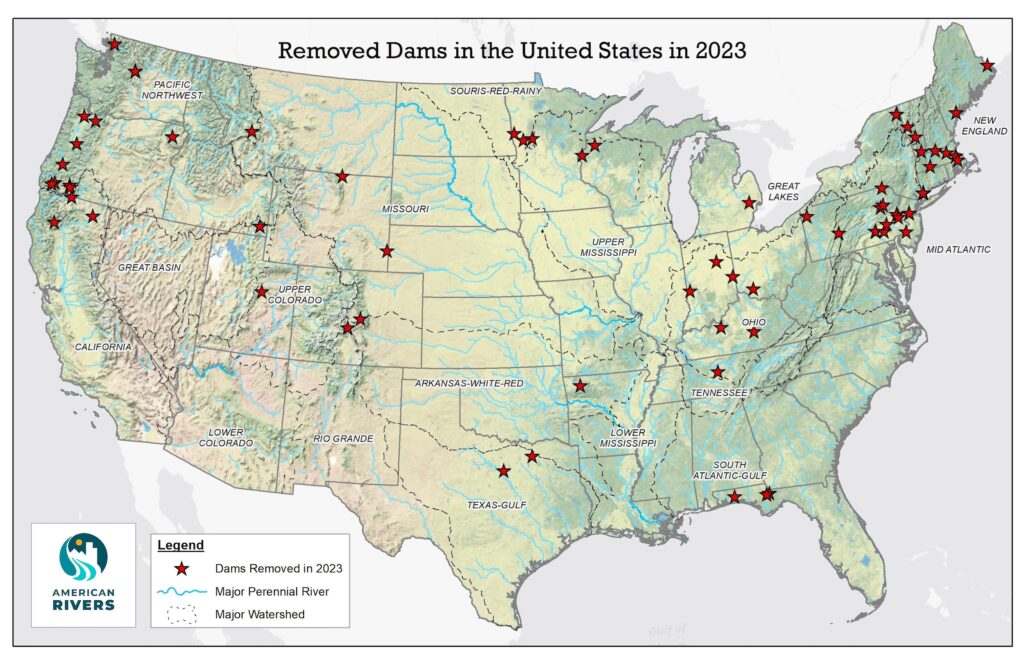
As many have heard by now, 2023 was a major milestone year for dam removal in the U.S., with the initiation of the largest dam removal project in the country on the Klamath River in California. However, you may not have heard about the 79 other dams that were removed, reconnecting 1,160 upstream river miles. These projects reestablished migration corridors, made natural and human communities more resilient to climate change, improved access to habitat to promote biodiversity, eliminated safety hazards and maintenance costs, enhanced access to rivers for local communities, reestablished natural processes for healthy rivers, and many other benefits.
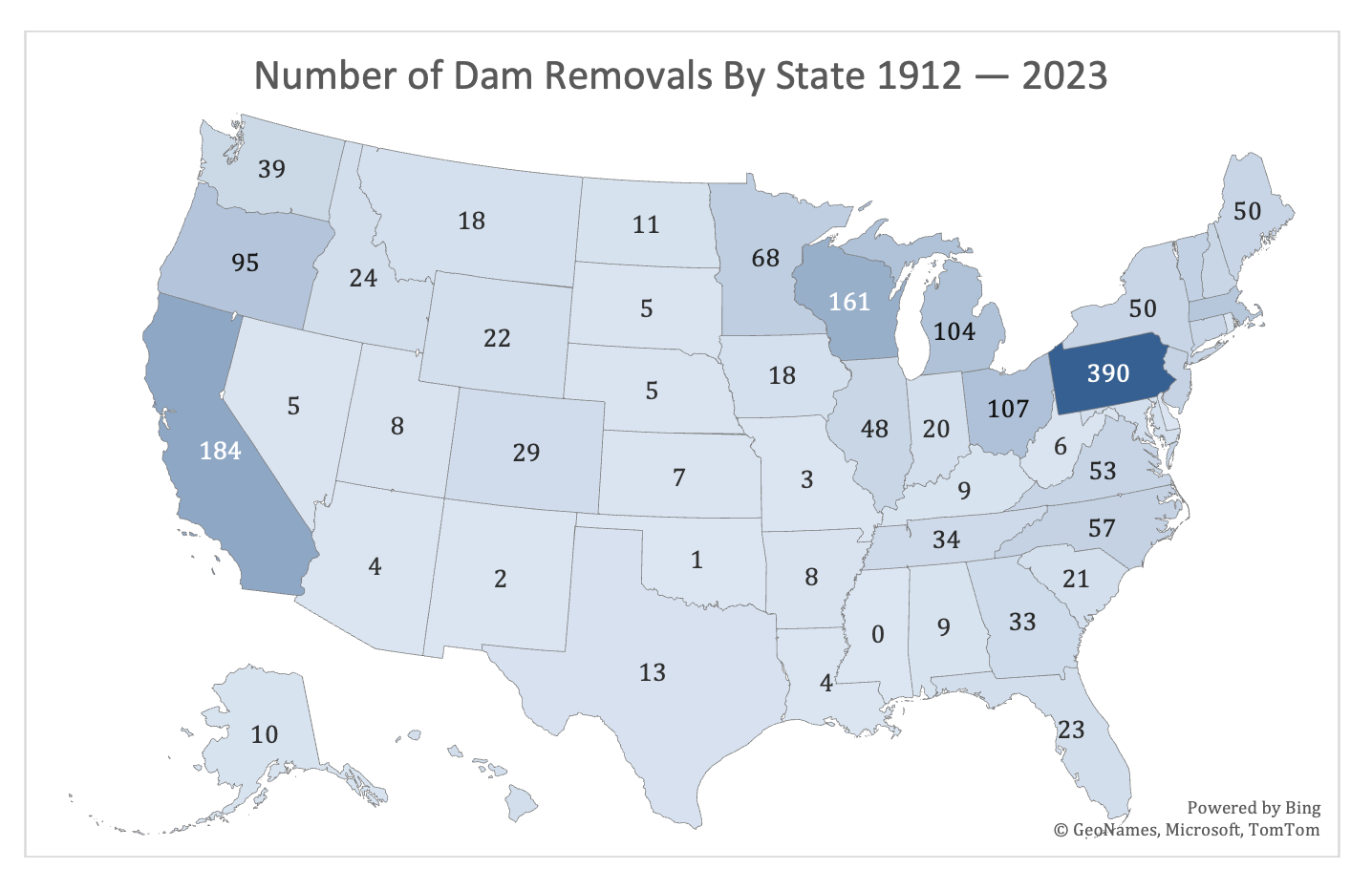
As a nationwide leader in river restoration, American Rivers tracks dam removal trends and maintains a national dam removal database. A total of 2,119 dams have been removed in the U.S. since 1912.
In 2023, the states leading in dam removal were:
Pennsylvania (15 removals)
Oregon (9 removals)
Massachusetts (6 removals)
Twenty-two other states also removed dams in 2023: Arkansas, California, Colorado, Connecticut, Florida, Idaho, Indiana, Kentucky, Maine, Michigan, Minnesota, Montana, New Jersey, New York, Ohio, Tennessee, Texas, Utah, Vermont, Washington, Wisconsin, and Wyoming.
Pennsylvania still leads the country in all time number of dam removals at 390!
As Katie Schmidt recently shared, the Bipartisan Infrastructure Law has promoted a bump in removals, helping with at least 18 of this past year’s projects. We need more funding like this in order to address the backlog of dilapidated infrastructure out there.
Many dams in the U.S. are no longer serving the purpose for which they were constructed and/or are deteriorating and in need of significant repairs. Dilapidated dams pose safety hazards and threaten the resilience of human and natural communities. This year, the National Low Head Dam Inventory Task Force, in partnership with the Southeast Aquatic Resources Partnership, catalogued hundreds of thousands of dams, bringing the national total to more than 531,000 dams. American Rivers is building a movement to remove 30,000 dams by 2050, in partnership with communities, Tribal Nations, and state and federal agencies, to ensure that rivers can continue to sustain life.
You can read more about some of the projects completed in 2023 in our annual dam removal summary.
If you work on dam removals in some capacity (practitioner, regulator, researcher, contractor, community advocate, etc.), we invite you to join our National Dam Removal Community of Practice. We will be working with this community to build out strategies to get to 30,000 dam removals by 2050. If you aren’t heavily involved in dam removal, but you still love the idea of it, we would appreciate your financial support to keep the lights on.
Lastly, if you want to hear more about some case studies from the 2023 cohort of dam removals, please consider joining us for a webinar on February 21 at 3PM ET. You can register here.
We can make this happen together!
If there is an animal you might see in every state in America, it’s Canada geese. Whether they are swimming in a river, hanging out in a parking lot, or chasing you down a street, Canada geese seem to appear out of thin air. They are noisy, large birds who don’t seem to have a rhyme or reason to their location. Given this, the question has to be asked, what is their deal?
After some brief research on these interesting animals via the Iowa Department of Natural Resources, I found that they actually do reside in every state in America including Alaska and even Hawai’i. They can even travel upwards of 1,500 miles per day, if the weather allows. This may be how they have made it to every state, although, still not exactly clear how they made it to Hawai’i.
Their habitat preference includes rivers, ponds, lakes, grain fields, fresh and saltwater marshes. Canada geese utilize their aquatic habitats throughout their life cycle. During the breeding season, Canada geese can mainly be found near lakeshores or riverbanks, as they often establish nests there due to the availability of water that ensures sources of food. These bodies of water are also great at providing protection from predators.
As the seasons change, Canada geese embark on their migratory flights, utilizing rivers as aerial pathways and lakes as rest stops for replenishing energy reserves. These wondrous birds fly south for the winter in a “V” shape, as most birds do. They form this specific pattern in order to fly faster and more efficiently. While migrating, these geese communicate with honks and switch positions in order for the main goose flying in front to not get too tired.
As many people may know, and have personally experienced, Canada geese can tend to be a bit aggressive to other animals and people. While this usually is during mating and/or baby season when they have their younglings, these geese seem to also be combative during any time of the year. Anyone who owns dogs or walks around rivers and parks where these geese are have most likely had one chase or hiss at them.
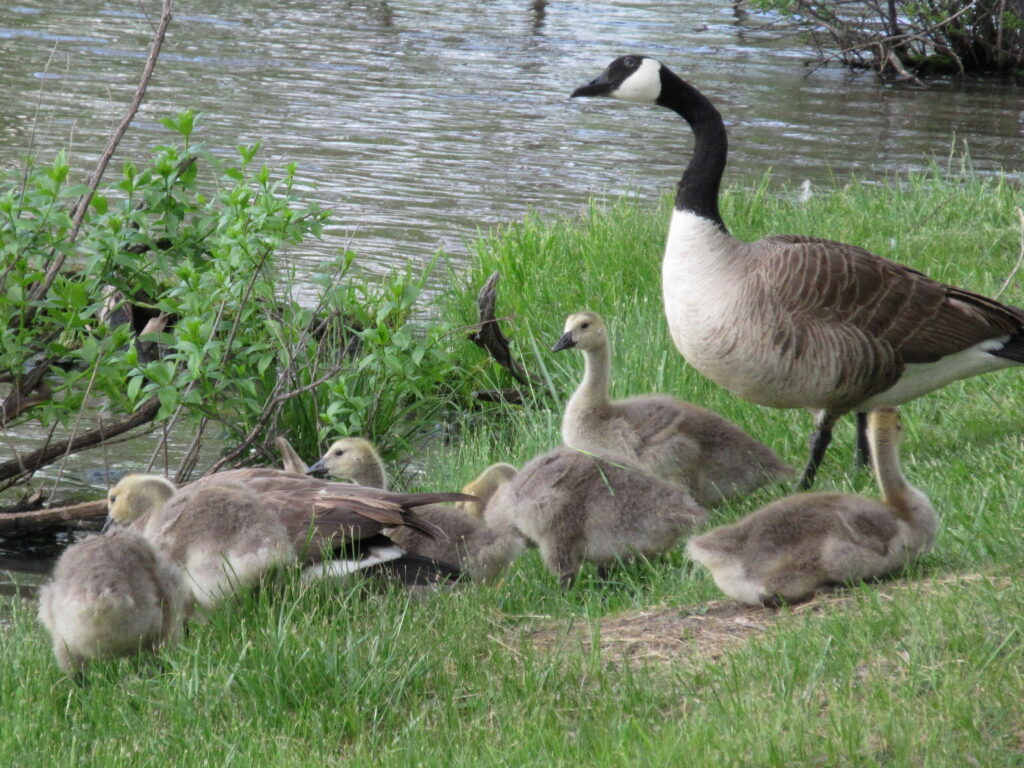
I for one grew up at a pond with a lot of them and have had several encounters of running from these large birds, dragging my dog behind me. One time in particular, I was sitting on a bench with one of my neighborhood friends when a flock near the pond started getting a little ‘too close’. The situation in retrospect was hilarious, although in the moment, my friend and I, being around 12 years old, did not find it so funny. It must’ve been the fact that we had sandwiches with us, or that we were less than 20 yards away, or that the weather was a smidge under perfect, but these geese were relentless. Before we knew it, my friend and I were running down the path back to her house, throwing our sandwiches and anything we could find at the hissing birds. Running from the geese quite literally felt like running from bullies who were trying to steal our lunch. Needless to say, for those next couple of days we mainly stuck to the other side of the pond.
Aside from the lovely ‘nature’ of Canada geese, a more loving fact about them is they actually tend to mate for life. Once a goose finds a partner, they will stay with them usually until one of them passes. I actually found this fact to be very sweet, and I envision (an understatement, I hope) this might give a more heroic factor to the aggressiveness of these geese and why they might be so protective. Going along with being loving, geese are extremely protective of their younglings, and essentially keep them at their side at all times. Parent geese use rivers and lakes to teach their goslings how to swim, as well as how to catch their own food.
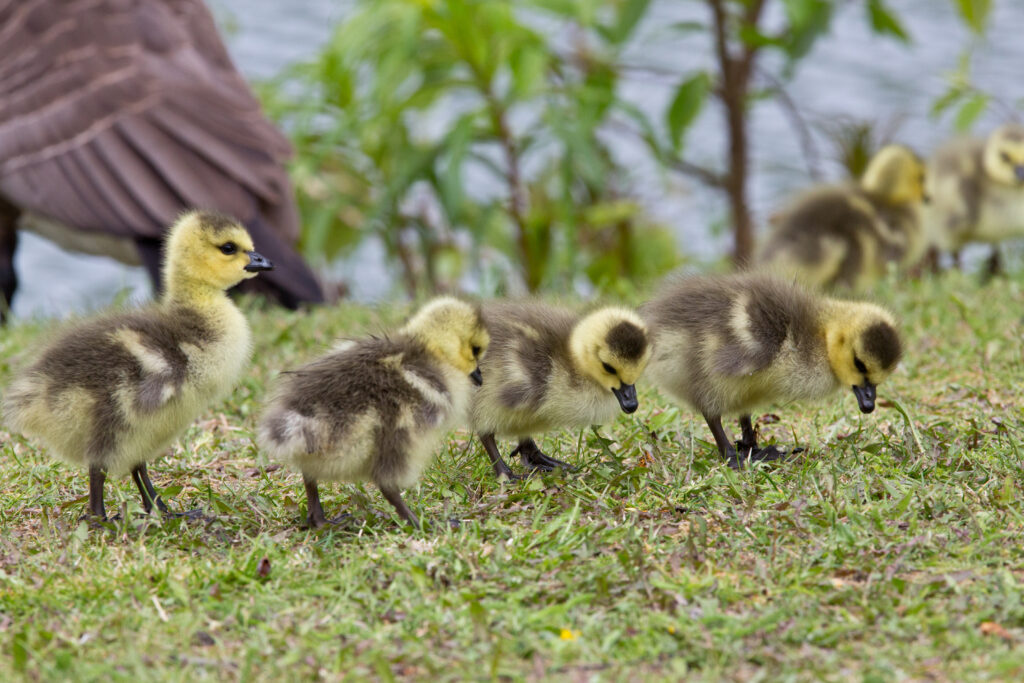
Overall, I would like to say that as interesting as Canada Geese are, I do still adore them and their fearless nature. While birds are normally flight animals, I would consider these geese to be more fight animals, and credit must be given in that area. They also are mainly aggressive in order to protect their young and mates, which is how the majority of animals in the wild behave with mothering instincts. Their migration patterns are fascinating, and their ability to live essentially anywhere is incredible.
The only personal advice that I could give if wanting to know how to coincide with these animals, is to admire their beauty and bravery from afar. These majestic birds are bold and fascinating, making sure that they are heard and respected in all communities, as they should be.
This is a guest blog written by Shelby Grund, the Digital Communications Intern, Winter 2023
On an early morning in late summer, with already a hint of fall in the air, the inaugural Indigenous Women’s Leadership Network (IWLN) river trip pulled away from the Sand Island launch on the San Juan River in southern Utah, along the border of the Navajo Nation. All river trips hold the promise–and very often manifest a reality–of experiencing something magical. There’s nothing quite like being on the water, sinking into the rhythm of nature’s time, and sharing the river with others. Anyone who’s been on a river trip can attest to this.
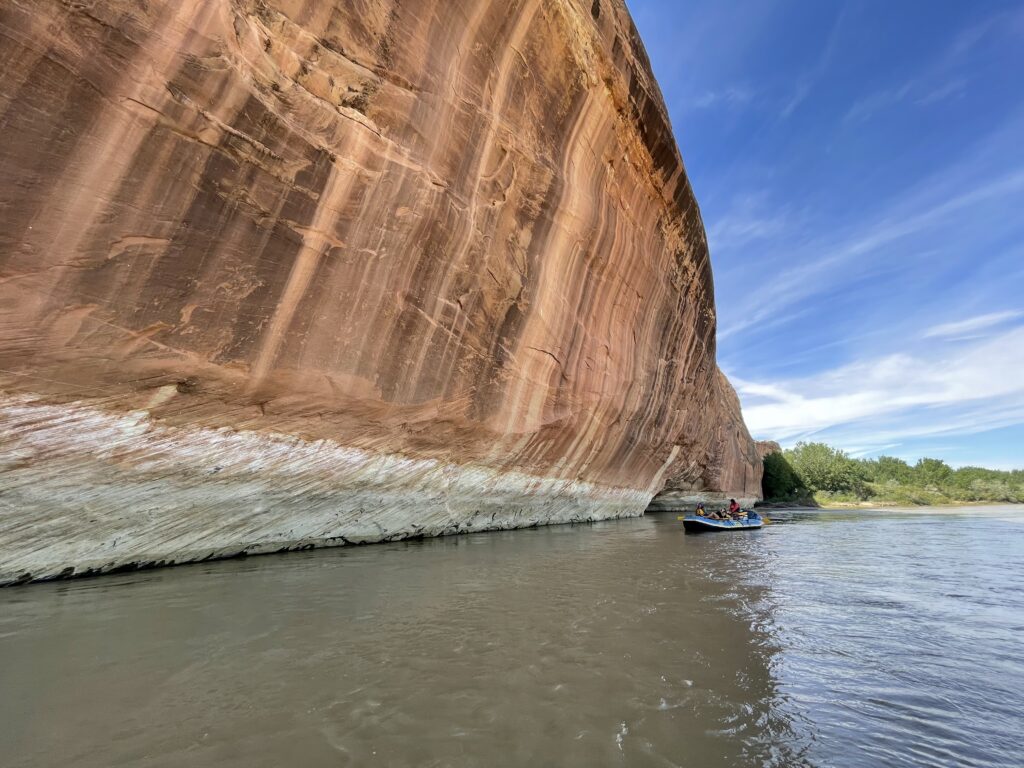
This trip held a particularly unique promise: To provide a fully funded opportunity for Indigenous women leaders and other emerging women leaders who work in the Colorado River basin, to experience a tributary of the Colorado River firsthand and to connect with one another. This trip was composed of all women, including the five river guides. Eleven of the 13 participants and one river guide were Indigenous. Four generations and eight different Tribes were represented in the group. It’s hard to overstate how exceptional this is for a river trip, which has historically been and remains a male and white-dominated space. Furthermore, it’s telling that while many of the women on the trip have spent their careers advocating for the waters in the Colorado River basin and for Tribes’ access to them, some have never been on a river trip in the basin themselves. To state the obvious, this needs to change.
This, amongst many other related changes, is IWLN’s vision. IWLN seeks to “create a platform for Indigenous women working on water and natural resource issues in Indian country to mentor and inspire each other, exchange information, build and refine skills in leadership, and to facilitate a succession of Native women in positions of leadership in their community.” Started in 2021, it is a project catalyzed by the Water and Tribes Initiative. IWLN provides a variety of opportunities including professional development trainings, networking events, and–beginning this year–an annual river trip.
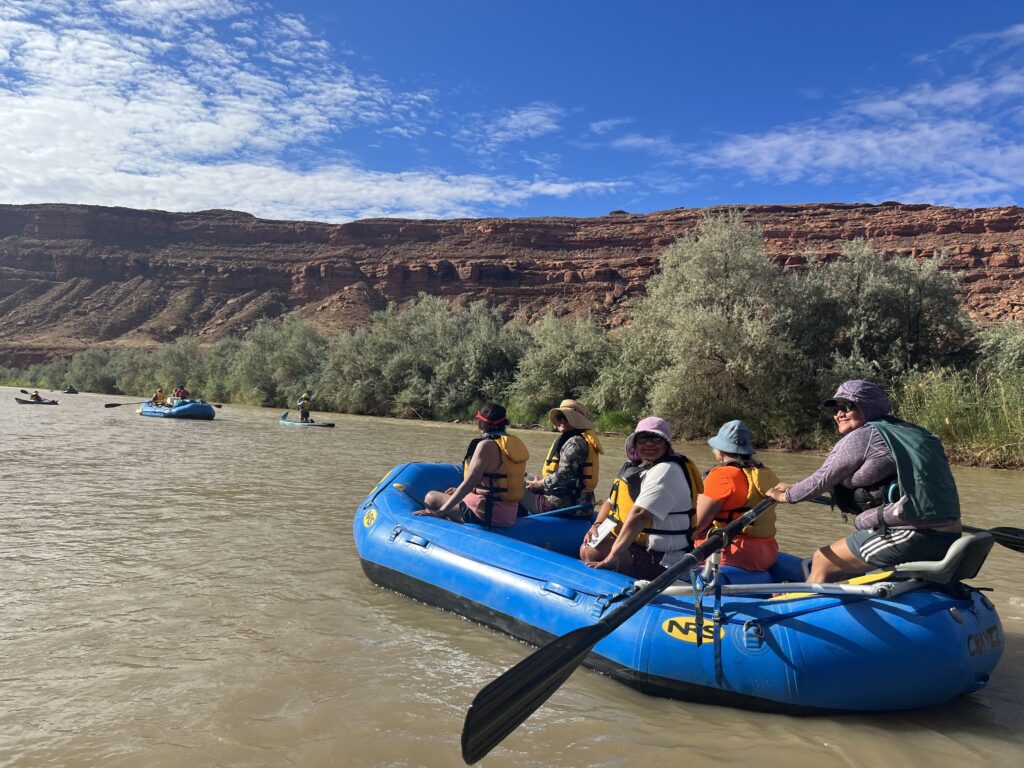
It’s easy to say that this trip was transformative. We spent four days and three nights together, traveling 27 miles along the San Juan and through the ancestral lands of the Hopi, Navajo, Ute, Paiute, Puebloan people, and others. The intentionally intergenerational group was composed of current and previous Tribal Chairwomen, water lawyers, conservationists, and grassroots community leaders. To be able to experience the waters that we work on, largely from afar, in direct ways—to play in it, to pray to it, to listen to it, to witness the other living beings it supports, and to learn new skills in how to interact with it—was incredibly powerful.
While there was discussion of water policy and current issues, the primary goal of the trip was to facilitate this shared experience with the river and to connect with one another. We had nightly group conversations on issues ranging from Tribes and the Colorado River, to mental health, to how to support each other in advocacy work. And, of course, there were shared meals, sing-alongs, and laughter all along the way. Indeed, the promise of experiencing something magical together on the river became reality. And the reality is that this must be the first of many IWLN river trips to come.
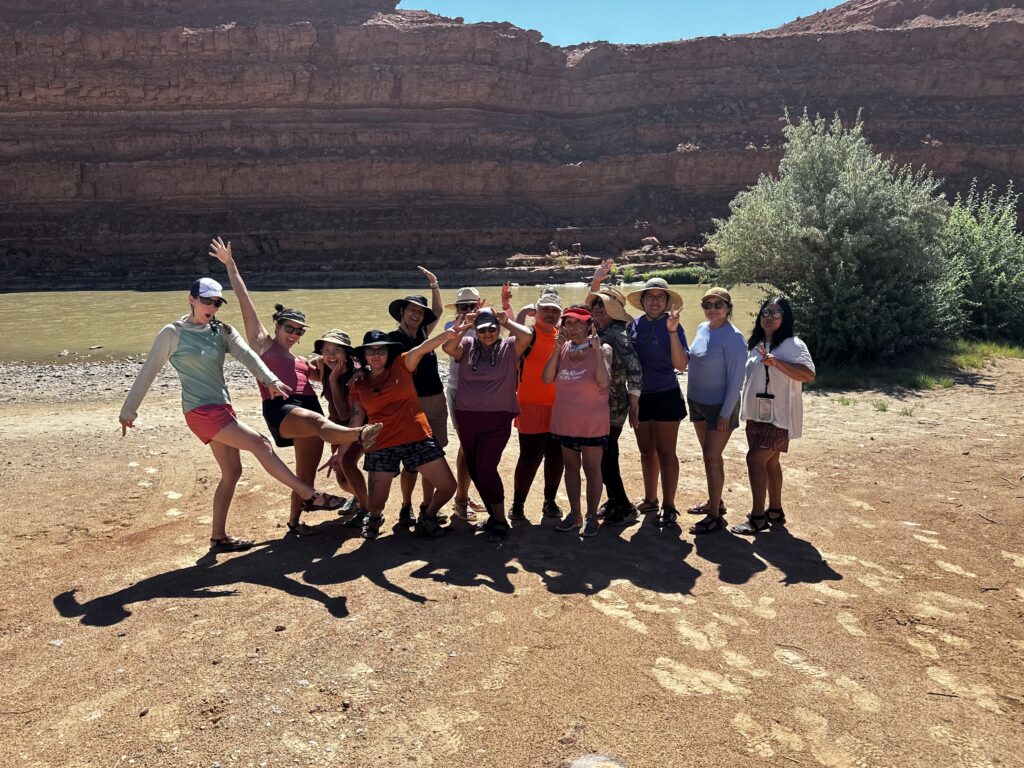
“Spending time on the river surrounded by strong, wise, and caring Indigenous women was pure medicine, and felt so sacred.”
Learn more and get involved in the Indigenous Women’s Leadership Network.
This San Juan river trip was made possible by the support of American Rivers and Planet Women.
Our successes this year are thanks to you — our supporters, partners, allies, and volunteers. As we reflect on the past 12 months of opportunities and incredible wins, we feel pride in what we achieved for your local rivers. We also feel resolve: We must protect nature in order to save ourselves and the beauty and magic of our planet in the face of climate change, the loss of nature, and racial injustice. With you by our side, we will be fearless in our efforts to protect the rivers close to your heart and others across the country. Because our communities, our health, our wildlife, and our survival itself depend on it.
WIN ✅ Klamath dams coming down for salmon and people
We are proud to have played an important role, alongside Tribal Nations and conservation partners, in advocating for the world’s largest dam removal and river restoration project currently underway on Oregon and California’s Klamath River. This time next year, salmon returning from the Pacific Ocean will swim upriver, past where four large dams once blocked their migration. These incredible fish will lay eggs in their spawning grounds and begin their species’ long road to recovery. Even if you’ve never heard of the Klamath, the reality of salmon returning — and what it means to local Tribes and the ecosystem — is breathtaking.
WIN ✅ Endangered Rivers became success stories
The 10 rivers featured in this year’s America’s Most Endangered Rivers® report underscore how health and safety are threatened by climate change, pollution, dams, and other threats to rivers and communities. Together, we must continue to defend these 10 rivers — and demand greater protections for all 3 million miles of rivers across our country.
Colorado River through the Grand Canyon, Arizona: The Bureau of Reclamation released a simulated flood into the dwindling Colorado River below Glen Canyon Dam. 39,500 cubic feet of water per second were released over 72 hours (that’s billions of gallons) to benefit endangered fish, restore wildlife habitat, rebuild beaches, and protect cultural resources in the canyon. Simulated floods like this one are extremely important to a healthy ecosystem in the Grand Canyon. What does 39,500 CFS look like? Watch the video.
Lehigh River, Pennsylvania: State Rep. Joe Webster introduced a bill to protect riparian buffers — vegetated riverside land that provides habitat, reduces bank erosion, filters pollution, and lowers flood risk. One of our asks in America’s Most Endangered Rivers® of 2023, the bill is especially important because it will help protect the Lehigh and other rivers across Pennsylvania from harmful development and stormwater pollution.
Clark Fork River, Montana: The Clark Fork is threatened by toxic waste left after the Smurfit-Stone pulp mill closed in 2010. By advocating at the local and state levels, we convinced the U.S. Environmental Protection Agency to speed up its testing at the mill site, which we are hopeful will help prompt the Biden administration to order a cleanup of the site.
WIN ✅ Turning federal $ into action for rivers
American Rivers played a leading role in drafting the legislative language and then securing $1.6 billion for dam removals and dam safety in the Bipartisan Infrastructure Law in 2021. We are now leveraging that funding and coupling it with your support to exponentially increase the number of rivers freed from dams.
- We are overseeing or advising on large, complex dam removal projects around the country. The Albright Power Dam on West Virginia’s Cheat River, for example. The project will open 75 miles of the Cheat and hundreds of miles of tributaries to fish species, including walleye, allowing them to secure habitat and food. And for the first time in 70 years, local communities will be able to boat, fish, and swim in this section of the Cheat.
- Thanks to our success in bringing together environmental groups, Tribes, and the hydropower industry for the benefit of rivers, American Rivers was selected to lead a $3.7 million project for the U.S. Department of Energy. The goal is to develop recommendations on dam safety, workforces, the federal dam-licensing process, and greenhouse gas emissions from reservoirs.
STILL FIGHTING ⏳ Supreme Court Ruling Puts Clean Water at Risk
For 50 years, the Clean Water Act, enacted with bipartisan support, has served as our most fundamental tool for protecting waters across the country. Yet, this past spring, the U.S. Supreme Court released a devastating ruling that dramatically narrowed the act’s scope. The court’s decision in Sackett v. EPA erased critical protections for tens of millions of acres of wetlands and made the clean drinking water sources for millions of Americans vulnerable to pollution and harmful development.
We can’t overstate the implications of the court’s ruling: The rate and severity of flooding and flood damages will worsen, clean drinking water sources for communities will be threatened, wildlife habitat will be destroyed, and water treatment will become more expensive, driving up costs for millions of people. Additionally, when these wetlands are drained and paved over, they will no longer serve as carbon sinks, absorbing carbon dioxide, making our fight against climate change even more of a challenge.
Gutting protection for half of our wetlands is the opposite of how to address the nation’s water and climate crisis. Rivers should unite us, not divide us. American Rivers will continue to stand with local partners and frontline communities to secure equitable protections for rivers and clean water nationwide. We will do everything in our power to work with Congress to rewrite the Clean Water Act and press states to enact tougher laws.
The change of seasons means many things for people, plants, and animals. In the Northeast, as autumn daylight shortens the deciduous forest’s spectacular colors emerge. Cooler, wetter autumn weather creates important signals for animals including the American eel, one of 12 migratory species that live in our coastal rivers. We are just beginning to understand the many often subtle environmental cues that influence animal behavior, whether that is temperature, light, pheromones, or noise.
As we enjoy the beauty of fall colors, adult American eels — having lived for up to twenty or thirty years in small headwater streams hundreds of miles from the ocean — will begin a downstream journey that ends in the Sargasso Sea in the Caribbean. These adults from along the Atlantic Coast are joined by others from across the Atlantic Ocean who have come from European Rivers to this same giant gyre of sargassum, a species of algae, commonly called the Sargasso Sea. While no one has yet directly observed the mating of eels, the adults spawn within the hundreds of square miles of sargassum and then die. The offspring, completely transparent and shaped like a willow leaf, catch the Gulf Stream and ride the currents back to either the U.S. or European coast. By the following spring, they begin to swim back up rivers first as “glass” eels and then as bigger juvenile “elvers”. These returning juveniles will swim against the current of spring freshets and often wiggle their way up and over the rocks and ledges that form the natural waterfalls and rapids.
And if you ever thought your commute back home through traffic was tough, think of the eels! It’s an incredible migration — adult eels have been found almost 400 miles from the Atlantic Ocean in the headwaters of the Connecticut River!
But unfortunately for the eels and the other creatures that depend on them, we’ve made that commute both down the river and back up again harder and often hazardous. Dams, particularly hydropower dams, were not designed to allow for the safe, timely, and effective (those are legal standards) passage up and downstream for fish using our rivers. Adult eels can be killed passing through turbines and upstream juveniles cannot get past the vertical faces of dams. And while there have been decades of attention to helping those charismatic fish like salmon, little attention was paid to eels which have been an important food staple for thousands of years.
There is some good news: Today there is widespread effort to ensure that all migratory fish can get to and from their river homes safely, including the American eel. The bad news? Getting known solutions implemented at hydroelectric dams as dam owners seek federal and state licenses as well as green certification is a challenge. Licensing proceedings take years and owners often push back because of costs, all while eel populations plummet. For example, a pending relicensing in the state of Maine for a series of dams owned by Brookfield Renewable Partners illustrated how hydropower dams have harmed American eels. A study required during the relicensing showed that close to 95% of adult eels would be killed passing through the turbines of these projects. This is a good example of the challenges eels and dam owners face in working to meet their legal obligations to public trust resources and safely pass these fish.
Why should we care about a shy and wriggly fish? Migratory fish like the eel are an important part of a functioning ecosystem that has evolved over thousands of years. They are an important food source, they bring marine nutrients not otherwise found in freshwater ecosystems, and all animals and plants have an inherent right to exist.
Want to read more? The Book of Eels (Ecco) by Patrik Svensson is a gentle and captivating narrative on the life history of several eel species and Svensson’s personal connections to these animals.
Want to see more? PBS Nature episode
Looking to really dig deep? Atlantic States Marine Fisheries Commission – American eel
There is an ongoing debate in the Pacific Northwest around whether hydropower as a whole is “good” or “bad”. But this conversation misses important details and nuance.
There are thousands of dams blocking rivers across the Northwest. Many dams provide energy, transportation, flood control, and irrigation. But many are causing more harm than good – and they are falling apart. As a society, we are making choices about the costs and benefits of dams: Which ones can be operated in a more environmentally friendly and economically viable way? And which dams need to be removed?
Dams harm rivers. They can destroy fish and wildlife habitat, degrade water quality, and turn free-flowing rivers into slow moving reservoirs that emit methane, a potent greenhouse gas that causes climate change. Dams in the Pacific Northwest have been a main cause of salmon extinction and a source of painful injustice for the region’s Tribal Nations.
American Rivers has always taken a pragmatic, solutions-oriented approach to dams and hydropower. While we lead the movement to remove outdated dams, we are also a founding member of the Hydropower Reform Coalition, working to improve the operations of dams whose continued operation is important for our energy supply and economy. For the past several years, we’ve also been working with the hydropower industry in the “Uncommon Dialogue on Hydropower, River Restoration, and Public Safety” – finding common ground on plans to retrofit and rehabilitate dams that still serve an important purpose and remove dams that pose a safety risk.
Simply put: American Rivers is ensuring our nation prioritizes healthy rivers, whether that’s by making hydro dams more river- and fish-friendly, maximizing the performance and efficiency of dams, and removing dams whose costs outweigh their benefits.
So, what does this look like in the Pacific Northwest where 50 percent of our annual energy generation comes from hydro? Major dams, including those on the Columbia River, helped build our world-class economy and will continue to support our vibrant region. But we must take a hard look at dams that are causing far more harm than good.
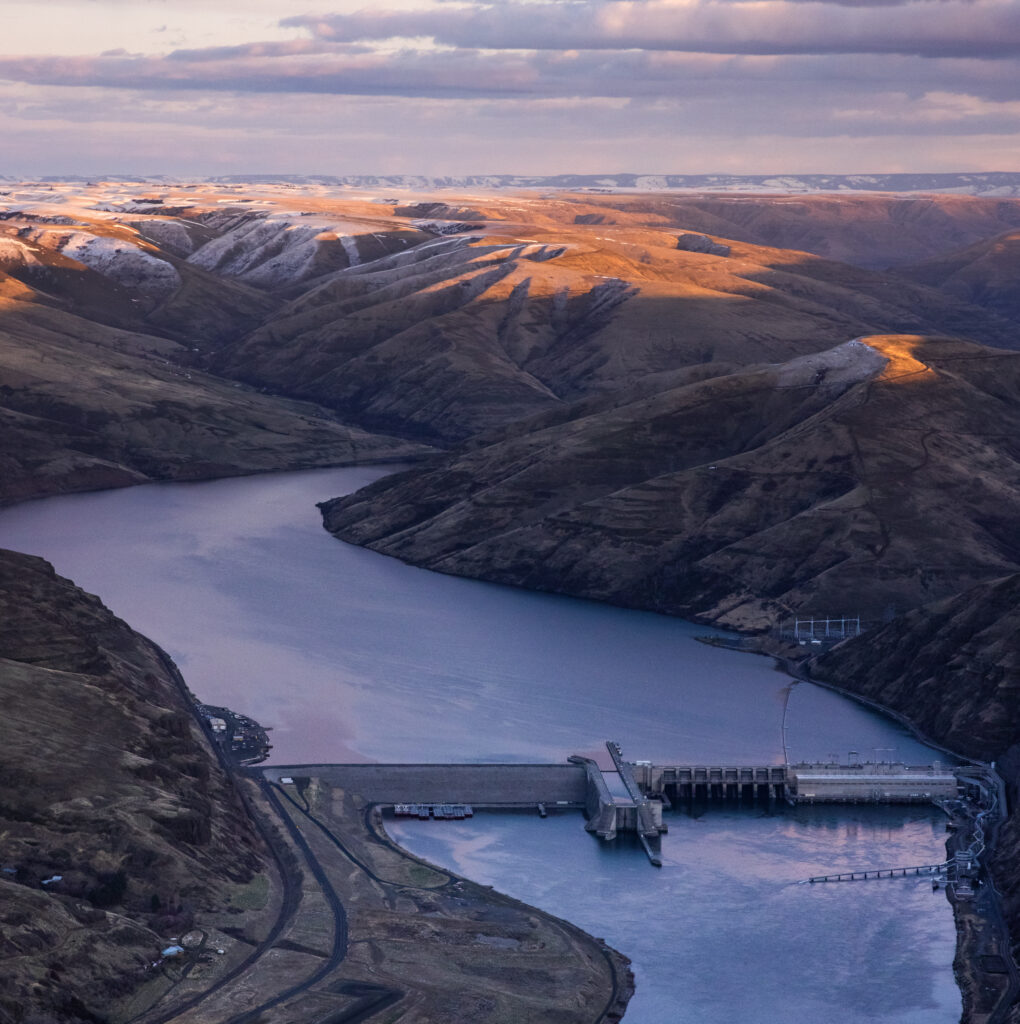
The lower four Snake River dams, which stretch between Tri-Cities, WA and Lewiston, ID, were constructed between 1957 and 1972. These dams provide around 900 average megawatts of power — around 4% of the Northwest’s energy generation. They also provide irrigation for crops grown around the Tri-Cities, as well as transportation for barge traffic between the Tri-Cities and Lewiston. While the services the lower four Snake River dams provide are valuable to surrounding communities, those services can be replaced with alternative technologies. Breaching the earthen portion of the dams is the best solution we have to solve the significant impacts the dams are having on salmon, steelhead, killer whales, Tribal Nations, and economies that rely on these species.
Unlike the mainstem Columbia dams, the lower four Snake River dams are “run of the river” projects that do not provide flood control and store relatively little water in the reservoirs behind each dam. In summer months, those reservoirs bake in the hot sun, raising water temperatures and creating harmful conditions for cold water-dependent salmon and steelhead. In 2015, warm water in the lower Snake was responsible for killing over 95% of the year’s adult sockeye salmon run. Impacts on juvenile salmon are harder to measure, but conservative estimates are that upwards of 50% of juvenile salmon die between Lower Granite Dam on the Snake and Bonneville Dam on the Columbia during their journey to the ocean, and that figure is likely much greater in years when water temperatures rise above 70 degrees.
As we mentioned before, the lower four Snake River dams combined produce an average of around 900 megawatts. Compare that with John Day Dam on the mainstem Columbia 50 miles east of Hood River, which by itself produces around 1,200 average megawatts, and you begin to see why these four dams are the target of so much attention. Four times the negative impacts from dams and their harmful slackwater reservoirs, for less power than John Day Dam alone just doesn’t make sense as we envision a new clean energy future.
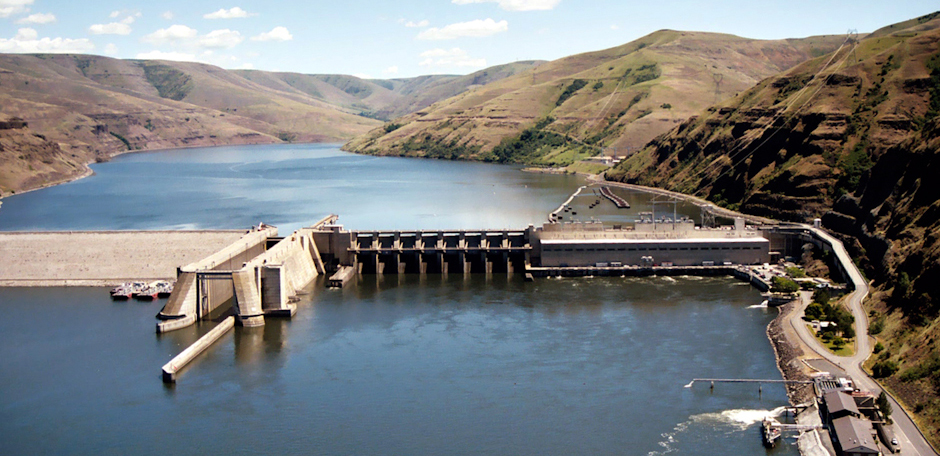
Finally, no form of energy can be considered clean if it leads to the extirpation of as many species as the lower four Snake River dams continue to cause, particularly when you consider the value those species have for Tribal Nations that have lived in the Columbia Basin since time immemorial. The American Fisheries Society, the National Oceanic and Atmospheric Administration, Trout Unlimited, and many other science-based organizations all recognize that breaching the lower four Snake River dams must be the centerpiece action for restoring salmon populations in the Columbia Basin.
Tribal Nations across the Northwest are leading this initiative to breach the lower four Snake River dams because of these negative impacts. The largest impact being to the salmon populations; their dwindling numbers directly impact the culture and traditions of tribal members and their future generations. In addition, with the harm placed on salmon by these dams, treaties made between the U.S. Government and the Tribes are being violated. We have a moral and ethical obligation to uphold our treaty promises and to save Snake Basin salmon and steelhead from extinction.
As we work to develop a bold new clean energy future for the Pacific Northwest, hydropower will continue to be an important part of our generation portfolio. When measured on the whole, it becomes clear that the lower four Snake River dams cannot be a part of that vision. We must build a system that is reliable, resilient, and equitable. We must continue working together to achieve a future of healthy rivers, abundant salmon, and affordable, reliable clean energy.
I sit on the banks as I write this, filled with awe and gratitude after seeing the Columbia River.
I am so emotional because the Columbia River is the final waterway that will carry me to the Pacific Ocean. I’ve paddled over 500 miles to get here, and I have become more invested in this river system than I could have possibly imagined.
As I have now entered the main body of the Columbia River, I feel it’s my duty to tell you about the issues facing the waterways I’ve passed so far, on my travels to this point. But first, a little about this journey:
The Columbia River Canoe Project is an expedition from the headwaters of the Clark Fork of the Columbia – Silverbow Creek near the Continental Divide at Butte, Montana – all the way to the Pacific Ocean. My cousin, Braxton Mitchell, and I will paddle or carry our custom-made Navarro canoe over 1300 miles on this expedition, living on the rivers we travel for the entire journey. Our goal is to really learn about the health of the river system and share our first-hand knowledge to benefit the entire watershed and its stakeholders. To this end, we have an incredible crew of filmmakers traveling with us to create a documentary about our experience, as well as the social and ecological concerns facing America’s rivers. In this case, I’ve chosen a few issues to inform you about.
The Scars of Progress
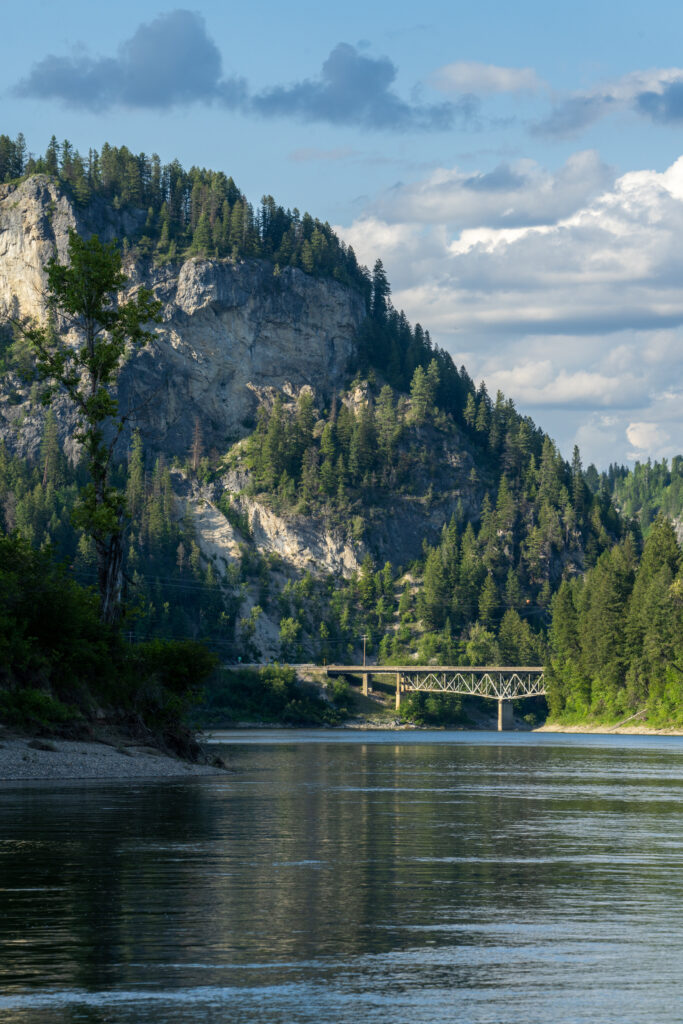
While the upper Clark Fork River flows inevitably into the lower Clark Fork, I see these two sections of the same river reversed in time. One possible future for the lower river has been written in the upper river. On the upper Clark Fork sits one of the most contaminated areas in the country, a problem so complex that the money and time it will take to fix the issues are almost incomprehensible. Meanwhile, on the lower Clark Fork, another ecological disaster rests at a tipping point.
Mining in the upper Clark Fork basin produced and processed the majority of U.S. copper during the industrial age. Advancement often comes at a price, and the scars of progress can now be seen in the upper Clark Fork watershed. The basin contains the nation’s largest superfund site, a mile-long acid lake, and an area where the Clark Fork flows over 19 million cubic yards of unaddressed toxic mining waste.
Downstream in the lower Clark Fork basin, below the city of Missoula and on the banks of the river, sits the Smurfit-Stone site, which is the remnants of a wood pulp mill that made bleached cardboard. While the mill no longer operates, 50 years of industrial waste remains in the Clark Fork floodplain. One of the most pressing concerns is that a large-scale flood will erode the inadequate earthen berm, causing toxins to be flushed into the river.
As we canoed by Smurfit-Stone, it was easy to see the horrific possibility of this threat. If you need more convincing, just look upstream. In 1908, a historic flood washed Butte-area mine tailings downstream, threatening life along the river, both ecological and human. A similar flooding event could occur at Smurfit-Stone with similar consequences. But there is an opportunity to prevent the upstream mistakes from reoccurring. Smurfit-Stone needs to be reclaimed while the cleanup is a relatively simple one, and before the drastic consequences of inaction become reality.
Smurfit-Stone is just the beginning, and the addition of the Clark Fork River to American Rivers’ Most Endangered Rivers Report of 2023 provides important recognition and a way for community members’ voices to be heard. But if you ask the people who live in the upper watershed in communities like Butte, they’ll remind everyone that until there’s a full cleanup in the upper watershed, the Clark Fork can never be healthy. Step one is cleaning the toxic Smurfit-Stone site, but don’t lose sight of the ultimate goal: a clean and healthy Clark Fork River from the Continental Divide to the Lake Pend Oreille Delta.
Big Trash, Simple Fix
There is a problem in this beautiful watershed, as terrible as any, that simply doesn’t get the coverage it deserves–trash and garbage in the river. Luckily, despite being one of the biggest problems, it has a simple solution that anyone can be part of.
Everyday during our trip, we picked garbage out of the river, and not just the types of items you’d think. We picked up chunks of Styrofoam coolers abandoned after riverside parties, basketballs lost to the currents, and a water cooler from an office. The trash we couldn’t extract from the river is much crazier – a half-sunken 35-foot boat run aground, full cars from every decade in the last 70 years, hundreds of pounds of coiled barbed wire, and even a broken trampoline that had been claimed by the wind. More concerning, though, is the staggering amount of plastic in the river. It’s heartbreaking to be in areas of this amazing river that are relatively untouched and see plastic bottles floating by.
The solution to garbage in the river doesn’t require government involvement or millions of dollars, just you. It comes down to prevention and clean up. Prevent more trash from entering river systems by securing your garbage and educating others on the importance of keeping trash from negatively impacting rivers. Cleanup is even simpler. You don’t have to join an organized river cleanup (although it would be great if you did). When you see trash, simply pick it up and dispose of it properly. Clean rivers benefit not only the ecological health of the river, but also guarantee a trash-free river experience for everyone, including future generations.
The Downstream Blind Eye
Industrial pollution and garbage can’t be addressed until we grapple with a principle that I finally understood as I paddled across the border into Canada. I call it the Downstream Blind Eye. Over and over, river impacts are passed to our neighbors downstream, and as soon as those impacts are out of sight, they are also out of mind. While the Downstream Blind Eye is a concept that can be seen in every watershed since industrialization, it is abundantly clear at the United States/Canadian border. The United States passes less-than-perfect water to Canada. Further downstream, Canada returns the favor by passing on to us pollution from a still-operating lead-zinc smelter. Both countries have turned a blind eye to the impacts passed across the border, and people have very little understanding of the issues on the opposite side. To the fish, eagles, bears, and countless other animals that use and rely on these rivers, our line on a map doesn’t exist and only water quality matters.
If the Downstream Blind Eye can be so apparent between two superpowers, then it’s occurring on every level, from states to individual landowners. At every scale, from local to international, a clean watershed can only exist if we take responsibility for our impacts and no longer pass them downstream for someone else to deal with. Pass on downstream only the water that you would hope is passed on to you from upstream.
Fight for this Watershed
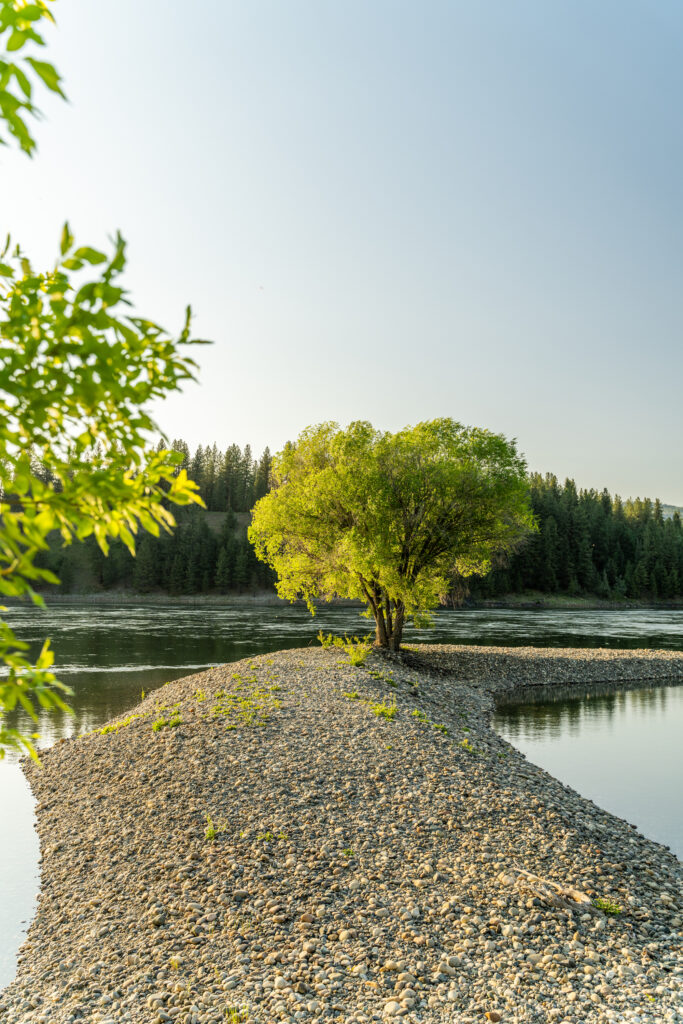
Talking about big serious issues can make people think that the problems are beyond repair or that a resource is no longer worth saving. I’m here to tell you that is not the case.
In this watershed there are landscapes worthy of our greatest national parks. Places where you can see a golden sunset over a 400-foot limestone cliff that was carved by the river. The confluence between a river so brown it could be flowing with chocolate milk and one so green it looks like liquid emeralds, and when they meet they don’t mix for miles. A spot where you can feel the power of a waterfall free falling into the river just by the wind it creates.
I’ve seen animal interactions on this river that most have only seen in National Geographic. Newborn deer taking their first wobbling steps along the river bank. A river otter that stops playing in the rapids to curiously watch as we pass by. Bald and golden eagles fighting above our boat to secure a fish that was snatched from the water only moments before.
So do not believe for even a second that problems can’t be solved and this river isn’t worth saving. The beauty is still there, and it’s worth preserving, not just for us but for all those who wish to see it in the future. Join the fight for the health of this incredible river system. And win.
Enjoy The Journey!
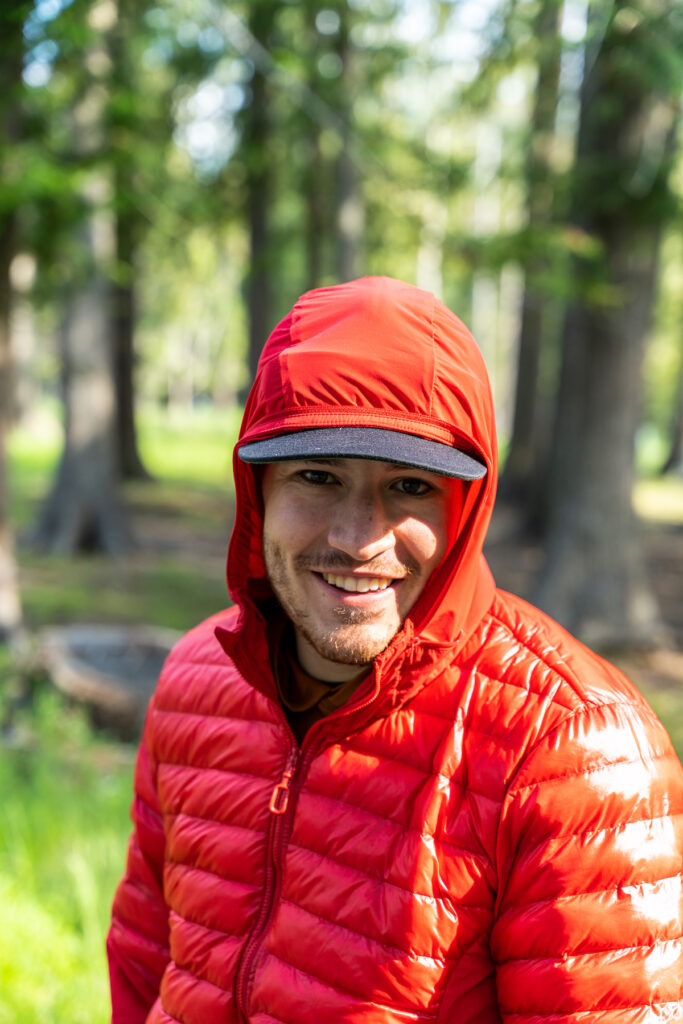
Kayeloni Scott, Communications Director at American Rivers, is a Spokane Tribal member and Nez Perce descendant who grew up in the Pacific Northwest.
The question was recently posed: What is your “why”? Why do I do this work? My immediate thought was, it just happened. As I reflected a little more, I do recall when the flip switched…
I’ve always been told that our Tribal history and culture are embedded in our songs and stories. This was vividly brought into perspective when a friend shared a story about taking their father to an old fishing spot that no longer had salmon; because of this they hadn’t been back there in years.
As they arrived, the father marveled in the special place and he began to sing. He sang a song his child had never heard and as he finished, he shared how he had forgotten this song of his ancestors. Coming back to this place allowed him to recall and share the song, its history, and meaning. This song, this piece of history, may have very well been lost forever had they not returned.
As I reflect on this story, I realize how minor this may seem to some. After all, what is the value of a single song? Short answer- you can’t put a price tag on it. For a group of people who have fought for centuries just to retain their culture; a single song could be the difference between extirpation and a path to healing. To think that a place could be the catalyst to healing, one must wonder what happens when even less, or worse, no salmon return to these places? We have to go elsewhere, and the songs and stories recalled at those particular locations are lost with the salmon.
Flash forward to when Rep. Mike Simpson released his Columbia Basin Initiative. Working for the Nez Perce Tribe, I was pulled in to provide communications services to advocate on behalf of this proposal. It was the job, something I was being directed to do. While I knew it was important, I was on cruise control just doing what needed to be done. During a meeting of Tribal leaders, one leader shared their reality.
This Tribe is what you’d call “a blocked nation”, meaning salmon can no longer reach these homelands. Meaning, their younger generations have never experienced fishing for salmon and all the history and traditions that come along with it. During this emotional story, the Tribal leader shared how they were able to start hosting these “cultural experiences” where they unloaded salmon from the back of a truck into a river just so The People could experience this part of their culture. For that Tribal leader, witnessing the joy in the children’s faces and the elders teaching the children how to fish traditionally, was a reminder of why they continue to fight to bring the salmon back.
For me, it was an eye opener to a harsh reality that is at our doorstep on the Snake River. It was in that moment I remember telling myself, “This cannot happen to my people or any other Tribes.” I couldn’t grasp the idea of my nieces and nephews not being able to learn these traditions. I couldn’t bear the thought of my dad no longer being able to partake in something that feeds his soul.
That moment is my why. The reason I’ve continued to advocate. Not because I want to, because I have to. Being privy to this information, it is my responsibility and obligation to use the skills I possess to help uphold our ancient covenant with salmon.
Salmon People are not Salmon People without their cultures and traditions; salmon are the cornerstone to both.
In a world where salmon are already in an uphill battle with climate change, we must make every effort to mitigate the impacts that we do have control over. The loss of a critical species such as salmon is unacceptable. The loss of a culture that is vital to the wellbeing of our country is unfathomable.
Salmon and their needs must be put first, for once! We can no longer sit back and act like the loss of their existence doesn’t have grand impacts.
The time to speak loud and clear, is now.
Sarah Uhl wasn’t always a visual artist. After a winding career that included time as a professional bike racer, marketing professional at New Belgium Brewery and Big Agnes, and producer of a film festival, the Coloradan realized that it was time to channel her love of nature into a career as an artist. These days, the new(ish) mom is a fulltime creative, working across mediums such as commercial illustration, live art, murals, and map design. She also teaches creative empowerment in workshops and retreats. Find Sarah on Instagram @sarahvirginiauhl. Shop her collection at our store.
What do you draw on for inspiration?
All of my inspiration comes from Mother Nature. I was lucky enough to grow up camping and playing outside in nature with my parents. I feel a deep connection to the land. Not everyone has the opportunity to form that bond early in life, and it is my hope that my art can help point people back to nature, inspiring them to build their own deep love of the land through curiosity and beauty. I paint what I feel more than what I see.
Tell us about the idea for this piece.
When I learned that the new motto for American Rivers was “Life Depends on Rivers,” all I could think about is how we are all interconnected with nature. I wanted to show that interconnected relationship. My first idea was related to the way a river delta looks like lungs and vasculature. I realized I could overlay my home watershed on top of an image of people in a way that the river takes on the look and feel of their veins … their lifeblood … their very existence.
It is not surprising that I landed on an image of a woman and a young boy, being a new mother to two young boys. The line work on the image is the actual waterways and mountain topography of the Roaring Fork watershed, a tributary to the Colorado River. The mother and son looking up towards the sun are showing a reverence for nature that I feel every day.
What inspired you about this project with American Rivers?
This job pushed me to refine my skills as an artist and to find the balance of creating beautiful imagery that draws someone into a story. It is my hope that this artwork creates curiosity and further inquiry into the interconnectedness of people and rivers.
What is your favorite river?
I am lucky enough to live beside the Crystal River in Colorado’s Roaring Fork Valley. This sacred river shapes the valley and awes me daily. I am so grateful to live beside a river that reminds me how precious and magical life is. There are so many distractions in our modern culture that pull us out of that awareness, and it’s a huge gift to be able to pull myself back into that connection to nature.
For our 50th anniversary, American Rivers is teaming up with five artists on original works that explore how important healthy rivers are to the future of humanity and nature. You can buy their limited-edition artwork at AmericanRivers.org/store.
Continued partnerships with community members in Bucksport provided for two additional rain gardens to be installed in early March. The community collaboration, that was developed during the first of two previous rain gardens installed last June at the James R. Frazier Community Center, expanded to include the South Carolina Native Plant Society. Its founder, Rick Huffman, owner of Earth Designs, offered his plant and landscape expertise throughout the planning and construction of the rain gardens.
Three recently certified Master Rain Gardeners, Trapper Fowler with Coastal Conservation League, Catherine Watts with Coastal Waccamaw Stormwater Education Consortium, and Victoria Green with Waccamaw Watershed Academy, at Coastal Carolina University, were able to gain hands-on experience and lessons to hone their new skills.
The videography was provided by Pierre Fignole, III, a student from Coastal Carolina University who is lead videographer on a community story mapping project that will encapsulate the Bucksport community story. The video documentation of the rain garden process will be developed for future use as an education module for community members.
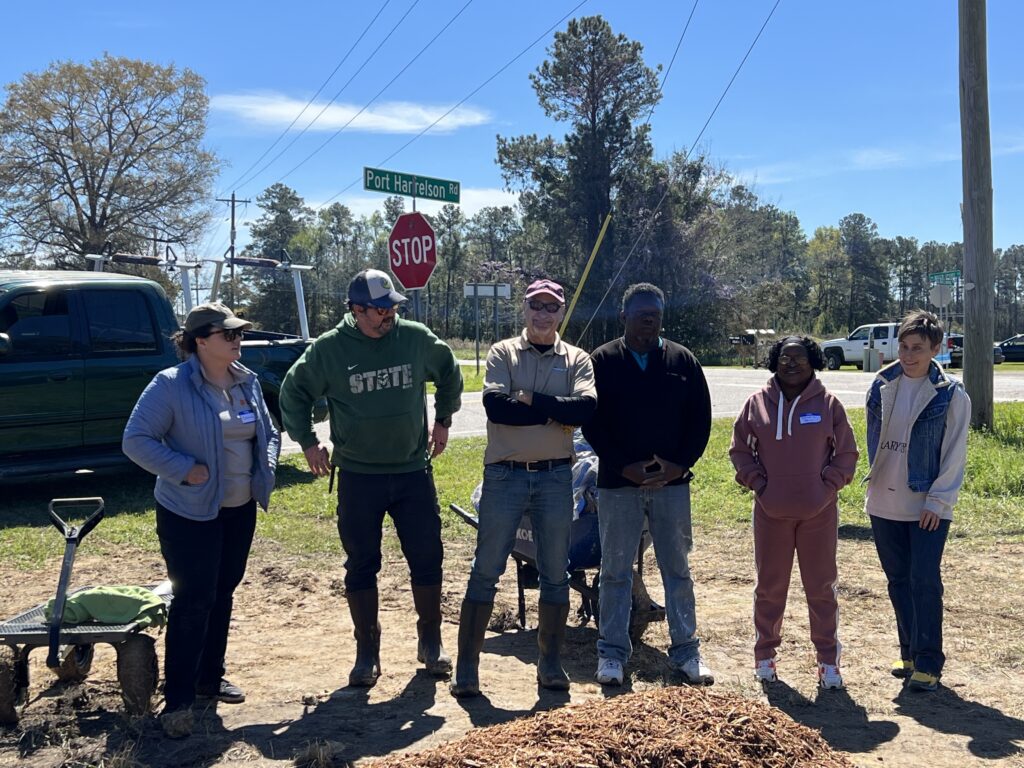
Throughout the process, community members were able to learn the steps for soil sampling and percolate testing to identify what materials would be needed for remediation of the soil at the sites. Two separate sites were chosen as being the most beneficial to aid with flood resiliency, as well as providing for high visibility and ongoing educational value.
The first rain garden was installed at a community member’s residence, one that has routinely experienced the impact of flooding resulting from excessive rain. Primarily, due to the timing of rain in the forecast and the location of the site, this phase of the project was conducted with limited community member involvement and was held on the Thursday prior to the Saturday event.
The second rain garden was installed at a highly visible location within Bucksport, across the road from Grace Chapel Church, an historic property that has been earmarked for restoration by the Association for the Betterment of Bucksport. The community’s plan for a future Farmer’s Market stand was a factor in choosing the second site’s location.
Although the weather was windy and somewhat cold, nearly a dozen community members participated on the day of the event. The process for preparation of the second rain garden was adjusted to include gravel and landscape liner to accommodate for drainage due to soil composition. Overall, the rain garden will serve, not only for its benefits of flood remediation, but it will also provide as a pollinator garden to attract bees and butterflies, with the added bonus of the aesthetics for beautification of the community.
The event closed out with community members being served lunch by Donnie Greene at Donnie’s Grill, a locally owned restaurant which offers southern and Caribbean cuisine.
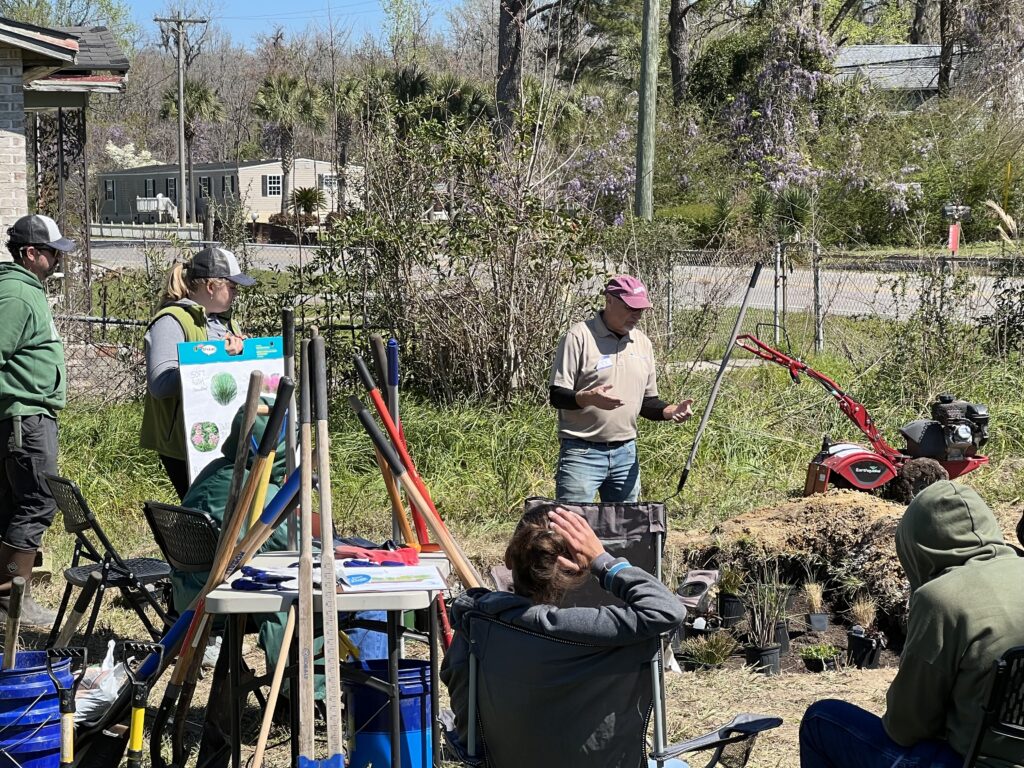
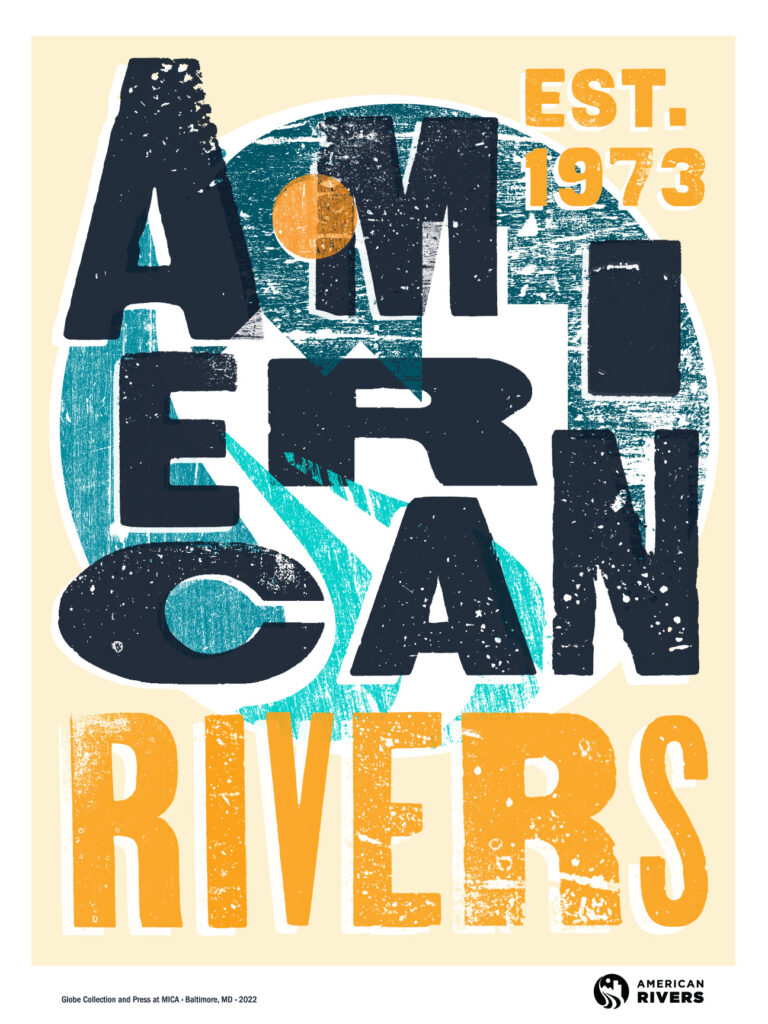
Art can inspire action! For our 50th anniversary, American Rivers is teaming up with five artists on original works that explore how important healthy rivers are to the future of humanity and nature.
The nation’s most iconic poster press Globe Collection and Press at MICA helps us kick off our five-part limited-edition art collection.
Learn more about Globe and visit AMERICANRIVERS.ORG/STORE to buy T-shirts, totes, posters, and more featuring this artwork and more from our 50th anniversary collection.
Globe has an incredibly cool history. Tell us about it.
Globe was founded in Baltimore 1929 and started out printing inexpensive posters for everyday people — so fairs, carnivals, boxing, racing, wrestling, big band. But it’s real claim to fame was in the 1950s and ‘60s with R&B and rock-and-roll posters for the likes of James Brown, Marvin Gaye, Aretha Franklin, Ike and Tina Turner, and B.B. King.
It was using a mixed-media process to produce these super-vibrant posters. Fluorescent backgrounds and bold black type became Globe’s trademark style. And its footprint wasn’t just Baltimore, it was sending posters everywhere from upstate New York down the Eastern Seaboard and along the Gulf into Texas.
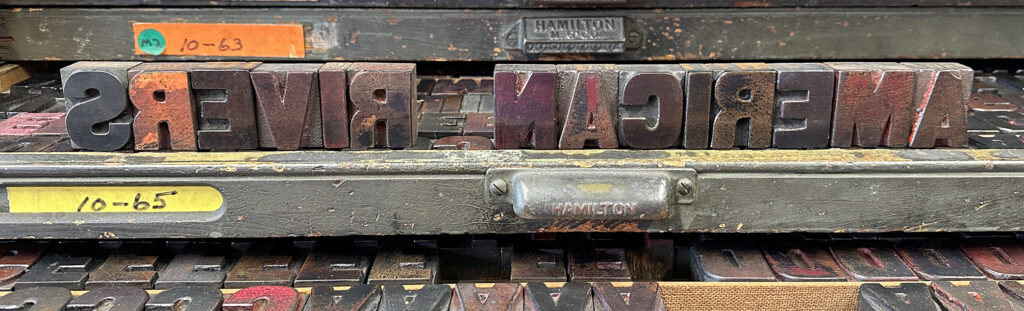
That carried forward into the late ‘70s to early ‘80s with go-go music and early rap and hip hop. And it held on until about 2011. When Globe finally closed, there was a community movement of artists and designers, historians, and students that activated to find Globe a new home and keep it in Baltimore, where it’s always been. The Maryland Institute College of Art, MICA, stepped up and purchased it when the press was 81 years old. It is one of the largest intact collections of letter-press printing materials of its kind in the country, if not in the world.
What is Globe up to now?
Now Globe is what we call a working collection. It has three jobs at MICA. We teach with it and pass on the tradition of the letter-press craft. We’re also slowly working on archiving the collection so it can be used for research and scholarship. And we also make new work with it. We’re using all of the great type and tools and stylings that made Globe famous. MICA has given us a lot of freedom to try a lot of different things. The collection has a really nice balance of commercial work, but we also do a lot of nonpartisan voter civic participation stuff and community-based projects.
Can you describe the process that Globe used to create the posters for American Rivers?
With any project, we always look to our archive materials as a place to start, whether it’s posters or wood blocks in our collection. This project with American Rivers was a little bit different because most of the time we design posters that need to be screen printed and letter pressed one at a time. This was a fun one because we didn’t have those same constraints. It gave us a lot of room to play with the wood type and the texturings from the collection to build up different layers.
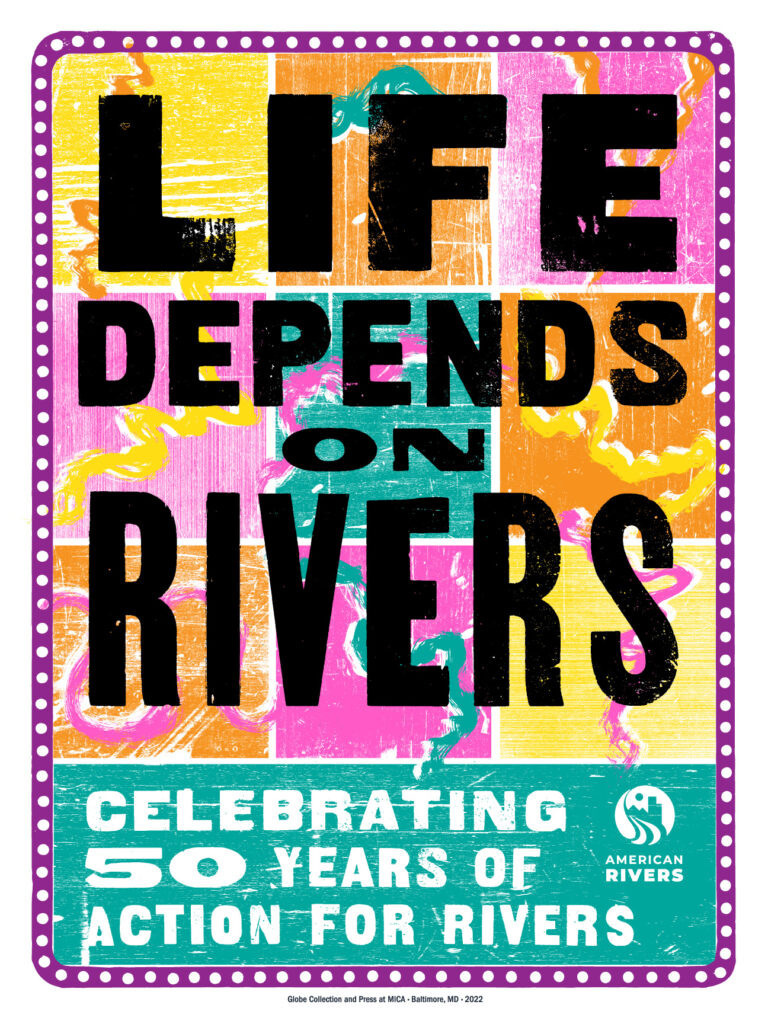
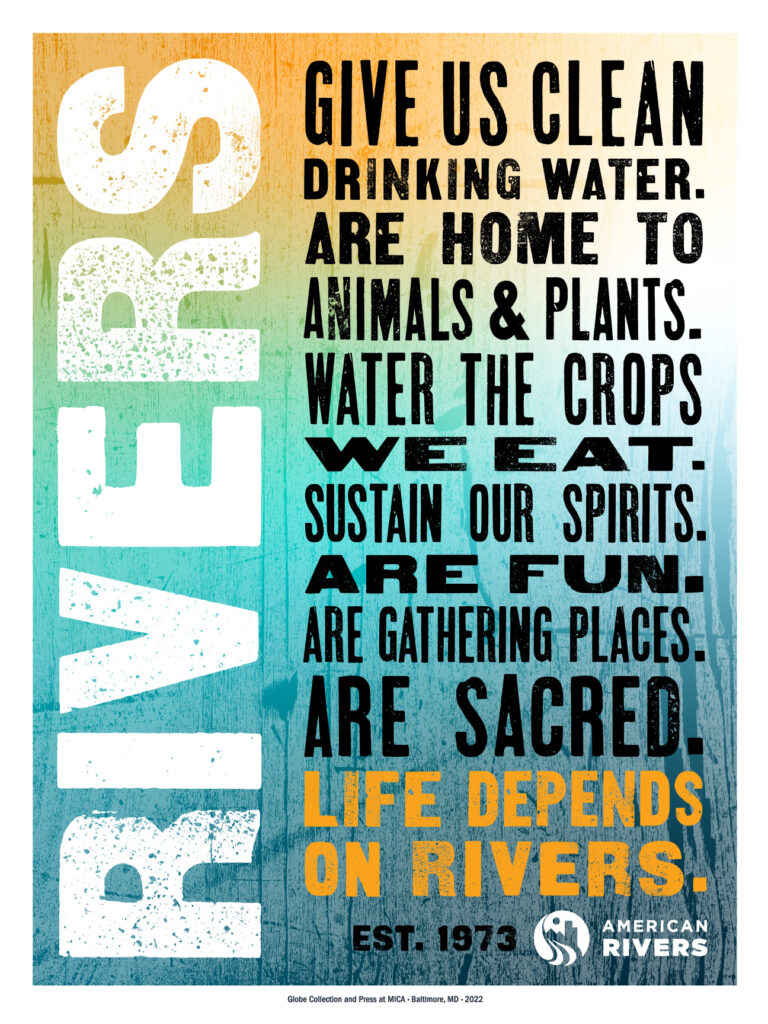
For example, take the poster that says, “Life Depends on Rivers.” That is the one that is most classically Globe, with a colored background and black wood-type text on top. We pulled the idea of the background from American Rivers’ annual list of America’s Most Endangered Rivers®. The background for that poster is made up of wood-type textured graphics of our loose interpretation of what the shape of those endangered rivers look like.
What inspired you about this project?
There’s a really nice symbiosis of using wood type as the base of these graphics. Because without rivers, trees don’t grow. We are kind of coming full circle in the materials that we’re using to do this design work — because it wouldn’t exist without water in rivers.
I really like design where you are constantly finding more information about it, whether it’s subtle moments where two pieces of type overlap or a color hits or something shifts just a little bit. I like those really quiet moments in design where things sync nicely or in a way you don’t necessarily expect them to.
To learn more about our Globe collection, please visit the American Rivers’ store.
California is living through a critical ecological moment, and the time has never been riper to build a movement around river health. From an intensive years-long drought to the recent series of atmospheric rivers that have inundated the state, we have been dealing with the whiplash between drought and flood, but also the emotional whiplash of an uncertain future. How should we respond to these changes as individuals, an organization and a statewide community?
One of the ways I’ve responded to the urgent climate crises of our time is to join American Rivers. For the past 20 years, rivers have guided my personal and professional choices, whether connecting me with the man who became my husband or guiding me through the various phases of my career: whitewater rafting guide, master’s and doctoral student, conservation partner, and scientist.
Committing myself to rivers – to saving them through collaboration and science – was an act of faith. Faith that if I made choices centered on what I believed was true – that rivers are the fabric that connect our lives – I would meet opportunities to do something good. My faith was rewarded with the opportunity to become American Rivers’ California Regional Director. It was also a reminder of the power of preparation. Faith and preparation are the tools we need now to secure the future for healthy rivers and the communities that depend on them.
In the Dreamt Land by Mark Arax, a vivid historical portrait of California’s Central Valley, Arax describes an amnesia that seems to grip California after extreme natural events. Floods and drought come and go with the seasons, and when they depart, we seem to forget where we live. We forget that to be in California is to be an inextricable part of its natural systems. Acknowledging our collective amnesia reminds us to prepare on all fronts. The rhythms of nature are cyclical, it’s extremes a perennial issue. And when circumstances change radically and suddenly, as climate change guarantees they will for decades to come, we can find ourselves reacting rather than responding.
As an organization, American Rivers needs to be nimble and prepared. We need to set up our work on a diverse array of fronts so that when an opportunity arises, we are ready to push forward with concrete solutions. Much of this work is already being done. American Rivers has been preparing and building resilience for half a century. 50 years of restoration has created deep impact on the ecosystems and communities of California. Our multi-benefit work in the floodplains of California’s Central Valley mitigates flood risk, improves ecosystem health and water quality, opens access to natural space, and provides essential habitat for the creatures we love. In the headwaters of the Sierra Nevada, we are tackling these problems at the source, restoring mountain meadows, mitigating wildfire risk, and more. And there is much more to do.
It is difficult to understate the critical importance of river health. When we reframe rivers as integral connectors of living systems, then it becomes clear that life depends on rivers. California depends on rivers. I depend on rivers. And I love them.
I’ll share that my favorite view of a river is the canyon wall at Nankoweap, a river camp on the Colorado in the Grand Canyon, where hundreds of millions of years of history have been archived in the rainbow catalog of rock formations. The human footprint at this site stretches back millennia, with the ancient stone granaries built by Ancestral Puebloan people still standing. We are not the first to manage these landscapes, nor will we be the last. Standing on the banks of the Colorado, it feels as if time itself is captured in the wall. The river has cut through and exposed millions of years through its natural course, a geologic reminder that no single person is responsible for our precious environment. Simply put, no one can do it all, but we can all do our parts.
We will be a blip in the geologic archive one day. And while nature persists and evolves, what will we leave for the people coming after to us to move forward with? I take comfort in knowing that I need to do my part, and that I can look to these amazing places as a reminder that if we focus and prepare, the opportunity to do something good will arise. Rivers are durable and dynamic, but they are not immortal. We need to steward the natural world with care, drawing on a range of wisdom and perspectives to inform and calibrate our approach to conservation. And we need to work together so that we can push forward together, breaking down the artificial barrier separating humans from the natural world we are a part of, lifting the haze of amnesia to train our gaze on the future of California.